Sustainable 3D Printing: Waste Reduction & Green Manufacturing
Published September 30, 2026 · By 3D Printzkart
· 5 min read
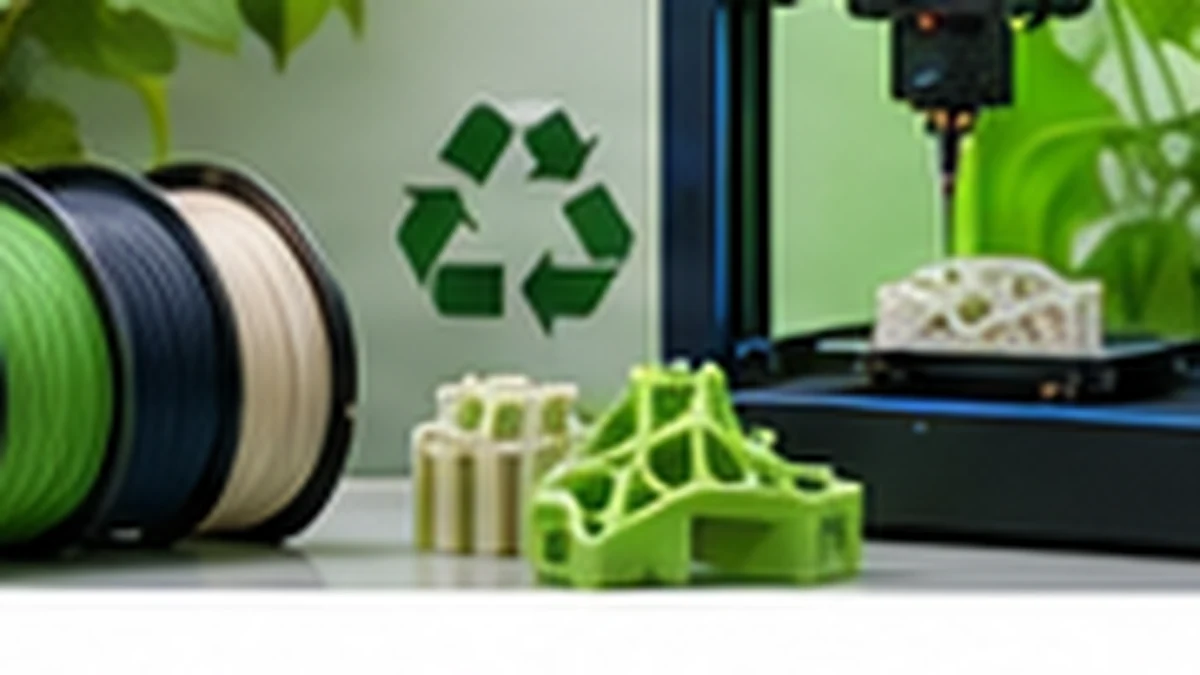
How 3D printing reduces material waste, energy use, and carbon footprint.
Key Takeaways
- Minimizes material waste
- Localized production reduces emissions
- Recycled materials increasingly viable
- Design for minimal material use
Introduction
Sustainable 3D Printing is reshaping how engineers, designers, and manufacturers build and validate parts. How 3D printing reduces material waste, energy use, and carbon footprint.
Whether you are a startup prototyping a first product, an OEM scaling production, or a researcher pushing boundaries, understanding the strengths, limits, and cost drivers of this technology helps you avoid costly mistakes, shorten development cycles, and ship better products.
Sustainable 3D Printing: Waste Reduction & Green Manufacturing
3D printing reduces material waste, energy consumption, and carbon footprint compared to traditional manufacturing — supporting sustainable production.
Environmental Benefits
- Less waste — additive process uses only needed material
- Localized production — reduces transport emissions
- On-demand — eliminates overproduction
- Recycled materials — growing availability of recycled filaments/powders
Best Practices
- Design for minimal material use (lattices, hollow)
- Use recycled materials where possible
- Optimize print parameters for energy efficiency
- Consider lifecycle impact of materials
Applications
- Lightweight designs — reduced material and energy
- On-demand production — no overstock
- Recycled materials — circular economy
- Local manufacturing — reduced transport
Why Bangalore & Pan-India
Bangalore's manufacturing ecosystem — aerospace, automotive, robotics, drones, medical devices, and consumer products — demands fast iteration and low-volume production. 3D printing delivers:
- Speed: Parts in 24-72 hours instead of weeks
- Cost: No tooling or molds for low volumes
- Flexibility: Design changes at near-zero cost
- Local production: Bangalore-based manufacturing reduces shipping time and cost
- Pan-India reach: We ship nationwide with consistent quality
Technology & Materials
Selecting the right material is the single biggest driver of part performance and cost.
Our Sustainability Service
We offer Sustainability with a wide range of materials, free DFM review, and fast turnaround. Whether you need a single prototype or a 500-unit production run, our team matches the right technology and material to your functional requirements.
Design Rules & Best Practices
Following these design rules ensures reliable, cost-effective parts:
- Wall thickness — minimum 1.2 mm for FDM, 1 mm for SLA/SLS, 0.5 mm for metal
- Tolerances — design for ±0.2 mm (FDM), ±0.05 mm (SLA/SLS), ±0.1 mm (metal)
- Holes — add 0.2-0.4 mm clearance for printed holes; ream critical bores
- Orientation — align load paths with print layers for strength
- Supports — minimize overhangs beyond 45° to reduce support material
- Clearance — maintain 0.2-0.5 mm clearance for assemblies
- Threads — use heat-set inserts or print with larger pitch; avoid fine threads in plastic
Do's and Don'ts
Do's
- Define functional requirements (strength, temperature, tolerance) before choosing a technology
- Request a free DFM review to optimize wall thickness, tolerances, and cost
- Choose the lowest-cost technology that meets your requirements
- Prototype early and iterate — 3D printing makes design changes cheap
- Validate with a small test batch before committing to large production runs
- Document design decisions and keep an iteration log
Don'ts
- Do not over-specify tolerances — design to process capability
- Do not ignore print orientation — it affects strength and surface finish
- Do not skip post-processing for parts that need specific finish or strength
- Do not assume 3D printing suits every part — evaluate CNC/molding for simple high-volume parts
- Do not neglect support removal and its impact on surface quality
- Do not order large batches without a first-article inspection
Cost & Lead Time
Costs scale with material volume, print time, and post-processing. Typical Bangalore pricing:
- Small parts (under 50 mm): Rs 200 - Rs 1,500
- Medium parts (50-150 mm): Rs 1,500 - Rs 6,000
- Large parts (150 mm+): Rs 6,000 - Rs 25,000+
Lead times: FDM 1-3 days, SLA/SLS 2-5 days, DMLS 1-3 weeks. Express service available for urgent projects.
When to Use 3D Printing vs Traditional Manufacturing
3D printing excels for complex geometries, low volumes (1-100 units), and rapid iterations. For simple parts at high volume (500+), CNC machining or injection molding becomes more economical. Many teams use a hybrid approach: 3D print prototypes, then transition to traditional manufacturing for production.
How 3D Printzkart Helps
Our Bangalore facility offers FDM, SLA, SLS, and DMLS with free DFM review on every order. We provide material recommendations, orientation optimization, and post-processing (sanding, painting, dyeing, vapor smoothing) to deliver production-ready parts. Contact us for a free quote and DFM review.
Conclusion
Sustainable 3D Printing is a powerful tool when applied to the right problems. Start with a clear functional requirement, choose the technology that meets it at the lowest cost, and iterate quickly. With the right partner and DFM guidance, you can move from concept to production-ready parts in days.
Frequently Asked Questions
Is 3D printing more sustainable?
Often yes — less waste, localized production, reduced transport.
Key Takeaways
- Minimizes material waste
- Localized production reduces emissions
- Recycled materials increasingly viable
- Design for minimal material use
Frequently Asked Questions
Is 3D printing more sustainable?
Often yes — less waste, localized production, reduced transport.
